Le 7 Paure · Book 1
Villa of the Shadows
When even memories become suspect.
Valeria Greco searches for answers about the death of her brother Matteo. An unexpected photograph and a neuroscientist’s call lead her to a villa in the hills of Superga. An old murder and memories she can no longer trust turn the investigation into a personal search.
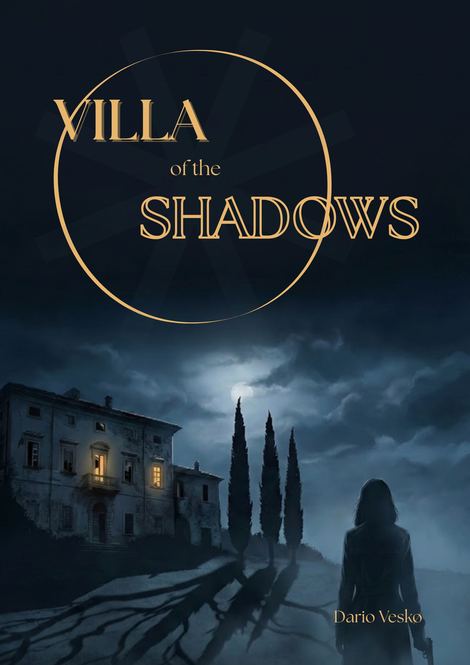
Dario Veskø · Le 7 Paure · Book 1
Explore the book
The chapter and cover shown here reproduce the English version already available on the website.
Free reading · the complete first chapter
Chapter 1 — The Invitation
Valeria Greco was eating cold tomato pasta straight from the Tupperware when the picture slipped out of the Brunetti file and fell into her lap.
The sour smell of old tomato and metal from the fork made her feel nauseous. She'd lost the habit of eating half-finished meals. In recent months, she'd been feeding more on internal reports and coffee than actual food.
Matteo.
Her brother. Alive.
Her brain reacted before her heart—an electric impulse, a shiver down her spine, her mind trying to translate the impossible into rational language. Her breath caught as if someone had stolen her air without touching her.
He was alive in this photograph. In an alley that Valeria didn't recognise. Taken before three bullets turned him into fifty-seven pages of an investigation report and a box of ashes that Valeria still kept in her wardrobe because she didn't know what else to do with them.
She set down her fork. Carefully. As if sudden movements might make the photo disappear.
In her head, the voice of the police therapist: "Grief is a process, Valeria. You can't skip the stages."
But Valeria had skipped four of the five stages and settled permanently in the fifth: anger. It was more productive than sadness.
The photo was a screenshot—low resolution, printed on plain paper, with irregular edges, as if someone had torn it off in a hurry.
Matteo was wearing that brown leather jacket. The one she'd given him after he'd spent three months staring at it in the shop window, claiming it was too expensive.
"Come on, an undercover agent can't afford Belstaff."
"Then stop being undercover."
"Then stop being stubborn."
"Impossible. It's genetic."
She remembered that evening: the bar near the station, music too loud, his stubborn smile. She'd taken a photo with her phone, then deleted it two days after his death—as if memory could obey a command.
In the photo, Matteo was talking to someone. A woman, out of focus, with dark hair pulled back in a bun that could have been elegant or hasty—impossible to tell. Her face was turned away from the camera with a precision that seemed deliberate.
But her posture was wrong for casual conversation. Shoulders too stiff. Hands clenched into fists.
Valeria had questioned enough suspects to recognise aggressive body language, even when blurred and in black-and-white.
She turned the photo over.
Handwriting in blue pen—decisive but careless, as if written in a hurry:
16 March 2025 – 48 hours earlier
Forty-eight hours before the call that changed everything.
"Inspector Greco? Superintendent Caruso. There's been an accident. Your brother—"
The rest was a blur. Valeria remembered the words— I'm sorry and operation compromised and everything possible —but not in the right order, not with the right voice. Her memory had edited that phone call so many times she no longer knew what was real and what was reconstruction.
But this photo—
It was new. And it shouldn't have been there.
The Brunetti file was a case of embezzlement, closed three years earlier. Valeria was only reviewing it because the police headquarters' computer system had crashed that morning, and some terrified intern had mixed up the files during the manual restore.
Someone had put this photo in the wrong file. Today.
The corner of the paper wasn't yellowed. The crease was fresh.
Valeria opened the bottom-right drawer—the one that technically violated twelve regulations but which no one ever checked—and pulled out the file.
GRECO, MATTEO — Undercover Agent — Deceased 18/03/2025 — Case Closed
Fifty-seven pages she'd read so many times she'd unintentionally memorised some lines:
"Subject shot three times. Two shots to the chest (right lung and left ventricle), one to the head (frontal lobe). Death was almost instantaneous—9 mm bullets, probably Beretta 92. No casings recovered. Professional or extremely lucky shooter."
The coroner had opted for professional .
Valeria leafed through to the end. Crime scene photos. Autopsy reports. Witness statements—few, useless, contradictory.
And there, hidden amongst pages of bureaucracy, a handwritten note.
She'd found it in Matteo's locker three days after the funeral. It hadn't been included in the official file because it seemed—as Caruso, the station psychologist, had said— "a product of extreme operational stress" .
Paranoia, in other words.
But Valeria had kept it.
The handwriting was Matteo's—angular, nervous. The letters seemed engraved rather than written, as if he'd pressed too hard to convince even himself.
"If anything happens to me, check Project Lethe. Maffei knows. It's not paranoia. It's real. They have infiltrators everywhere. Don't trust—"
The sentence ended there. The pen stopped mid-word—a thicker stroke of ink, then nothing.
The void had its own voice, and it said everything Matteo hadn't had time to write as if someone had disturbed him. Or as if Matteo had realised the list of people not to trust was too long.
Project Lethe.
Valeria had searched. Police database—nothing. Interpol—nothing. Online searches—a Greek mythological river associated with oblivion. Useful for crossword puzzles, useless for investigations.
And Maffei.
Alberto Maffei. Neuroscientist. Specialist in cognitive neuroscience and memory manipulation.
She'd heard him speak once, in a crowded lecture hall. The calm tone of someone who knew they were dealing with something frightening.
He'd said, "Remembering isn't a natural act—it's a chemical choice."
At the time, Valeria had thought it was just provocation.
Not anymore.
They'd met at that conference two years earlier. He'd presented a case about a man who'd convinced an entire family they had false memories of abuse that never happened.
Brilliant. Disturbing. The kind of person who saw human beings as collections of rewritable synapses.
The telephone on her desk rang.
Valeria stared at it for four rings, counting them. No one called the office at this hour unless someone had died. Or was about to die. Or—
Fifth ring.
She picked up the receiver.
"Inspector Greco."
Silence. Not a void, but a populated silence. The kind of silence where someone breathes on the other end, searching for words or courage or both.
Valeria looked up at the ceiling, locating the four security cameras covering the office.
"If this is a prank, I have video recordings and call tracking. I'll be at your door by tomorrow morning."
"It's not a prank."
Male voice—sixty-something, polite Turin accent, but with an underlying tension like a violin string pulled too tight.
"And I'm not on camera. I'm on the phone because having this conversation in person would be dangerous. For both of us."
Valeria recognised the voice half a second before the man introduced himself.
"Alberto Maffei."
Pause.
"Professor," Valeria said slowly. "What a pleasant surprise. Thirteen minutes to midnight. The perfect time for a social call."
"You received the photograph."
The world tilted slightly.
She looked at the photo on the table. Then at the cameras. Then, at the window, total darkness beyond the glass.
"How do you know—"
"Because I had it inserted. Three hours ago. I still have contacts at police headquarters." A calculated pause. "I had to be certain you'd listen."
"Listen to what, exactly?"
"Who is the woman in the photograph with your brother."
Valeria felt something tighten in her chest.
"Professor, if you know anything about who killed my brother—"
"Come to Villa Maffei. Friday evening, seven o'clock. Superga Hills." His voice became urgent. "I've gathered all the people involved in another case. A murder eleven years ago that was filed away as an accident. And I fear the killer—the same one who killed your brother—wants to strike again."
Valeria grabbed pen and paper.
"Name of the victim, eleven years ago?"
"Davide Torre. Researcher. Explosion in a private laboratory. Case closed within forty-eight hours."
"If you suspect murder, file a report. Protocol—"
"Protocol requires the police to investigate." Maffei laughed—a joyless sound. "But the local police closed the case before the fire brigade had even finished putting out the flames. It didn't matter that the forensic evidence was contradictory. It didn't matter that Davide had rung me three hours earlier, saying someone wanted to kill him. Case closed."
"Why?"
"Because someone with power—a great deal of power—wanted it forgotten. Literally forgotten." Pause. "And they have the means to do it."
She looked at Matteo's note.
Project Lethe.
"The project my brother was investigating," she said. "Is it connected to Torre's death?"
"Inspector, your brother wasn't investigating Project Lethe. He was part of it. Without knowing it."
The phone almost slipped from Valeria's hand.
"Explain."
"Not on the phone. Never on the phone." Maffei's voice trembled. "But I'll tell you this: Matteo came to me six months before he died. He told me he had gaps in his memory. That he woke up in places without remembering how he got there. That sometimes he made decisions he didn't understand. I thought it was operational stress."
"And instead?"
"It was neurochemical manipulation. Someone was using on him the same technology that killed Davide Torre. And when Matteo began to resist—when his unique neurology rejected the manipulation—he became a problem to be eliminated."
Valeria closed her eyes. She breathed. Four seconds in, eight seconds out. A technique her therapist had taught her to manage anger.
As usual, it didn't work.
"Do you have evidence?"
"I have a diary. Davide's laboratory diary, hidden for eleven years in a cavity in the wall. I only found it last week." Heavy pause. "And I have witnesses—people who were there that night. Who were manipulated to forget but who now, perhaps, can remember."
"Who'll be there on Friday?"
"Everyone who has something to hide. And one who has everything to reveal." Maffei's voice broke slightly. "And, Inspector? Come armed. Not because there'll be violence—I hope not. But because the killer is one of us. And when they find out we're about to expose them, they'll react."
"You're using me as bait."
"I'm offering you justice for Matteo. Are you willing to take that risk?"
She looked at the Polaroid photo pinned to the notice board above her desk. She and Matteo, twelve years old, at the funfair. Cotton candy on their faces, silly smiles.
On the back, Matteo's childish handwriting: "Me and Val against the world. Always."
"I'll be there," she said. "But if this is a game, Professor—"
"It's not a game." Relief, palpable. "It's the last chance for justice for people who've been erased. In every sense."
"What does that mean?"
"It means that when the time comes, you'll discover that memory isn't just who we are. It's a weapon. And someone's been using that weapon for eleven years. But the window's closing."
"Why now? Why after eleven years?"
A long silence. Then, so softly that Valeria had to strain to hear:
"Because I'm starting to forget. Me too. Like Matteo. And if we don't act within three days, I'll forget everything. Who am I. Why it matters. And the killer will be free forever."
The line went dead.
She stood motionless with the receiver in her hand, her ear still straining as if she could recapture the voice on the other end. The silence that followed was so thick that for a moment she thought she could hear her own blood rushing through her eardrums.
Valeria sat in the empty office, staring at the photo of Matteo and the faceless woman.
Then she did something she hadn't done since Matteo died.
She opened the secret drawer under the table—the one that technically didn't exist, the one she'd installed the night after the funeral—and pulled out a Nike shoebox.
She placed it on the desk.
Inside were Matteo's personal belongings—things she'd managed to save before someone had "cleaned" his flat. She touched them as if they were organs that had survived a body that was no longer there.
Keys. Wallet (empty—someone had taken everything). Phone (SIM removed, battery dead). Watch (broken, stopped at 11:47 p.m.). And three Polaroids.
Valeria took the watch—a digital Casio, the one Matteo had always carried. The display was cracked, frozen at 11:47 p.m.
The time hit her like a punch.
11:47 p.m.
The exact time Elena had died in 1992, according to the death certificate she'd found on her father's USB stick.
Thirty-three years earlier. To the minute.
Coincidence?
Valeria didn't believe in coincidences.
She spread the photos out on the table.
First Polaroid: her and Matteo at the funfair, the one she knew.
Second: Matteo in uniform, on the day he was promoted to detective. Serious, professional, but with that half-smile that said, I can't believe they pay me to do this.
Third—
Valeria stopped.
She didn't remember this photo.
Matteo in a laboratory. White coat. Surrounded by scientific equipment.
And next to him—Alberto Maffei.
Younger, thinner, but unmistakable.
Valeria turned the Polaroid over.
Handwriting that wasn't Matteo's:
"Subject 017—Neurological baseline—Initial test 15/08/2019"
Her hands trembled.
Subject 017.
Not "Detective Greco" . Not "Agent Matteo" .
Subject.
The word had the same effect on her as a bite on the back of her neck. It wasn't a neutral term. It was a condemnation.
If Matteo had been a test subject, then what was she? A control variable?
Valeria searched her phone. She found Maffei's number—not the one he'd called from, but his official university number.
She dialled.
Ring. Two. Three.
Answering machine: "You've reached Professor Alberto Maffei. Currently on leave for personal reasons. For emergencies, please contact the Department of Neuroscience."
Valeria hung up.
She looked at her watch: 00:03.
Friday night would be here in less than forty-eight hours.
She picked up her personal phone. She dialled a number she rarely used.
Two rings. A sleepy voice:
"Val? It's midnight. Has someone died?"
"Ricci, I need a favour."
Silence. Then:
"How illegal is it?"
"On a scale of one to ten? Eight."
"Christ." The sound of Ricci getting up, already awake. "Tell me."
Valeria's Flat — Thursday Morning, 6:47 a.m.
Valeria hadn't slept.
The night hadn't even really arrived. She'd spent it sitting on the floor, her back against the wall, the light from the monitor like an open wound.
Every time she closed her eyes, she saw Matteo turning into a wet alley and someone shooting at him from off-screen.
So she decided to keep busy.
She started building a timeline on the living room floor, using Post-it notes and red string like in the crime TV series Matteo used to mock.
"Come on, no one literally uses red string. It's a cliché."
"It works."
"It works to make us laugh about it."
But Valeria wasn't laughing now.
She had three parallel timelines:
TIMELINE A — Death of Davide Torre (2014) 20 March, 9:00 p.m.: Davide rings Maffei, says he fears for his life 20 March, 11:47 p.m.: Explosion in the laboratory 21 March: Davide declared dead 23 March: Case closed as "accident."
TIMELINE B — Death of Matteo (2025) 16 March: Matteo meets mysterious woman (photo) 18 March, 11:47 p.m.: Matteo killed 19 March: Case opened as "ambush during operation." May 2025: Case closed, no suspects
TIMELINE C — Maffei Rings Valeria (2025) 10 October: Maffei finds Davide's diary (assumption) 16 October, 11:47 p.m.: Maffei rings Valeria 18 October, 7:00 p.m.: Scheduled meeting
Three events. Eleven years apart.
All connected by:
Time: 11:47 p.m. (Torre dies, Matteo dies, Maffei rings) Person: Alberto Maffei (present or connected in all three) Word: Lethe
Valeria noticed the pattern.
Coincidence? Impossible.
The specific time—11:47 p.m.—repeated three times suggested a meaning. Symbolism. Or provocation.
Someone wanted her to notice.
The intercom rang.
Valeria checked the video feed.
A man in his fifties. Expensive grey suit, leather briefcase. Hair perfectly combed with gel that glistened under the porch light. Teeth too white—professionally whitened, probably every six months.
She didn't recognise him.
She took the Beretta from the table. She checked: magazine full, safety off.
She opened the door, leaving the chain on.
"Yes?"
The man smiled. Professional, calculated, without warmth.
"Inspector Greco? I'm solicitor Santoro. I represent the Maffei family."
His voice was too calm. He smelt of expensive tobacco and polite lies.
Valeria sized him up in a second: tailored suit, calculating eyes—the kind of person who always has shadows behind them.
Valeria didn't lower her gun.
"I don't remember asking for legal representation."
"It's not for you."
He passed an envelope through the crack. Thick, cream-coloured, sealed with wax.
"Professor Alberto wanted to ensure you had everything you needed for the weekend. Considering the... distance to the villa."
Valeria took the envelope without opening it.
"What's inside?"
"Cash. A thousand euros. For travel expenses." The smile widened. "And a key to the villa. The professor says you'll need it."
"Why can't he give it to me himself?"
"Because Professor Maffei is... indisposed. Stress. It's understandable, considering what he's planning."
The solicitor adjusted his glasses.
"And, Inspector? A word of unsolicited advice—take your gun. Villa Maffei has a complicated history. Three deaths in two hundred years. People tend to get lost there."
"Lost how?"
"Geographically. Mentally." He shrugged. "The distinction matters when you're dead."
And he walked away, his shiny shoes clicking on the pavement.
Valeria closed the door.
She knew it was a trap. No solicitor brings cash at six in the morning. No solicitor speaks in riddles about people who lose their minds.
But she accepted the envelope—not because she trusted him, but because it was the only lead she had.
She opened it.
Inside: exactly one thousand euros in fifty-euro notes. The solicitor's business card. And a key—antique brass, oxidised, with intricate geometric patterns engraved on it.
On the key's collar, stamped:
VERITAS VOS LIBERABIT
The truth will set you free.
Or, Valeria thought, it will get you killed.
Underneath the key was something else. Small. Wrapped in tissue paper.
Valeria unwrapped it.
A photograph.
Old—the 1990s, perhaps the late 1980s. Faded, with worn edges.
Two little girls. Identical twins, one or two years old. Standing in front of a building that Valeria didn't recognise.
And between them, kneeling, a woman.
Valeria looked more closely. The face was familiar but distant, like something seen in a dream.
She turned the photo over.
Different handwriting—feminine, shaky:
"Maria, Valeria, Elena—Summer 1991"
The floor tilted.
Maria. Her mother. Valeria. Herself. Elena.
Valeria had no sisters, only a brother. She was an only child. Her father had told her a thousand times: "You're all we have, little one. Our only, precious child."
But there were two girls in the photo. Identical.
Like the ones in the video on Francesco's USB stick—as if to confirm what Valeria still didn't want to accept.
The image trembled between her fingers. Not because of the weight of the paper, but because of what it represented.
Goosebumps ran up her shoulders. Her mind searched for explanations—cousins, mistake, photomontage...
Valeria ran to the bathroom.
She vomited cold pasta and bile and something that tasted like fear.
Central Police Headquarters — Thursday Afternoon, 2:23 p.m.
"You're joking."
Detective Ricci—fifty-two years old, twenty-five years of service, a belly that spoke of too many lunches with too many courses—stared at Valeria across his office desk as if she'd gone mad.
Which, Valeria had to admit, was a real possibility.
"I'm not joking."
"You want to go to an isolated villa with people you suspect of murder—"
"Two murders."
"— two murders, based on the word of a scientist who talks about 'forgetting' and a photo you have no memory of but which apparently shows you with a sister you never had."
Put like that, it sounded bad.
"Yes."
Ricci leaned back in his chair. The chair groaned. He ignored the groan like a man with long experience of ignoring the complaints of chairs.
He had one of those faces people described as "honest" : deep lines around his eyes, grey sideburns he'd never considered dyeing, a badly broken nose that had never been fixed.
But it was his eyes that betrayed his intelligence. Brown, alert, seeing more than they let on.
"Val."
He used her name, not her rank. Bad sign.
"Matteo died six months ago. You did everything you could—you investigated, you left no stone unturned, you threatened three superintendents and a judge. And you found nothing."
"Because I wasn't looking in the right place."
"Or because there was nothing to find."
Kind but firm. Ricci leaned forward.
"Matteo had been working undercover for eighteen months. He was infiltrating an arms trafficking ring—bad people, justified paranoia. And when you're that deep—"
He made a gesture with his hand, like sinking into water.
"—You start seeing patterns where there aren't any. It's a defence mechanism. Your brain searches for threats everywhere because threats are everywhere."
"The note he wrote—"
"It was paranoia," Ricci said. "Painful, but paranoia. 'Don't trust anyone' is a classic symptom of psychological breakdown under prolonged cover. I've seen it happen to men stronger than Matteo."
Valeria knew he was right.
The rational, trained, professional part of her knew she was doing exactly what the manual said not to do: chasing ghosts because accepting reality was too painful.
But.
That damned photo with the little girl who wasn't supposed to exist.
That damned call at the exact time Matteo died.
And that feeling—the instinct of blood—that told her there was some truth behind all this.
"If I don't ring you by two o'clock tomorrow," she said, "send someone to Villa Maffei, Superga."
Ricci sighed. Long. Like deflating a balloon.
"You're impossible."
"I'm your partner. It's in the contract."
"The contract says 'professional collaboration' , not 'follow colleague on suicide mission based on—'"
He paused. He looked at Valeria. Really looked at her, the way he did when he was about to say something important.
"That's not it, is it?"
"What?"
"Suicide mission."
Ricci took off his glasses, cleaned them with his tie, and put them back on. Time to think.
"Val, if there's something—if you need to talk to someone—"
"That's not it."
"Because police suicide is a real risk. And after Matteo, with the pressure, with the cases that don't get closed—"
"It's not that."
Valeria stood up.
"It's just that for six months I've accepted the official version. And every day that version makes less and less sense. And now someone's offering me answers. They may be lies, they may be manipulation, but at least they're something ."
Silence.
Then Ricci did something unexpected.
He laughed. Didn't chuckle— laughed . Deeply, sincerely, with a touch of resignation.
"What?" Valeria asked.
"Nothing. Just that—"
Ricci stood up and went to the metal cabinet in the corner. He opened it with a key he kept on a chain around his neck. He took something out.
"—if you're going to do something stupid, at least do it with decent equipment."
He placed it on the table: a miniaturised ambient microphone, a GPS tracker, a taser more powerful than the standard issue.
"Ricci—"
"Don't say anything. Officially, I haven't given you anything. Officially, I don't know where you're going. But unofficially—"
He approached her and placed his hands on her shoulders. Heavy, warm.
"—if you don't ring by two o'clock tomorrow, I'll come with four cars and enough firepower to make Superga look like Fallujah."
Valeria felt something tighten in her throat.
"Thank you."
"And Val? Whatever you find there—whatever truth, whatever lies—remember that Matteo wouldn't want you to die trying to avenge him."
"I know."
"Are you sure?"
Valeria didn't answer.
A4 Motorway, Towards Superga — Friday, 6:12 p.m.
The rain started forty kilometres before Turin.
The windscreen became a continuous sheet of water. The drops ran like thoughts: too fast to follow them all, impossible to stop.
The radio crackled on dead frequencies. The GPS stubbornly searched for a signal.
She was alone with the engine's sound and her own questions.
And Valeria began to think that perhaps the universe was trying to tell her something.
Like, "Turn back, you idiot."
But Valeria Greco had never been good at listening to advice. Not even when it made sense.
She drove on.
Leaving the motorway, the road climbed—narrow and winding. On both sides, dense woods that seemed closer than necessary. Trees leaning out as if to grab the car.
No other cars in any direction. Just Valeria, the storm, and three thousand unanswered questions.
Maria, Valeria, Elena.
Who was Elena? Twin sister? Dead? Gone?
And why —WHY—had her father never told her?
Francesco Greco had been many things: an honest policeman, a loving father, a man who did the right thing even when it cost him.
Valeria would never have thought he could be a liar.
Yet he'd hidden the existence of an entire person from his daughter.
The GPS said, "Destination in three kilometres. Keep right."
Then it died—black screen. No satellite. No connection.
Valeria continued to drive based on instinct and memory. She'd studied the area: maps, satellite images. She'd memorised every bend, every junction, every—
The gates appeared through the downpour like an apparition.
Wrought iron, three metres high, green with oxidation and moss. Half-open.
Not wide open in welcome. Not closed in refusal. Halfway—as if the villa hadn't yet decided whether to welcome her or reject her.
Valeria stopped the car. She left the engine running. She got out into the rain.
The water hit her like a hammer.
Cold, violent, deliberate. In three seconds, she was soaked.
She approached the gates. She studied the wrought iron—nineteenth-century craft, probably original. Engraved symbols: roses, snakes, stylised skulls.
And on the right pillar, at eye level—
The symbol.
A perfect circle, as large as a plate. Divided into seven equal segments by lines as precise as if drawn with a ruler.
Valeria ran her fingers over the grooves. Deep. Deliberate. Ancient—moss grew inside them, bright green contrasting with the grey stone.
She'd seen that symbol before.
Where?
Her memory was slippery, unreliable like grasping wet soap.
She took three photos from different angles.
She pushed the gates.
They opened with a long, metallic groan—a sound that, in the silence of the hill, seemed to scream:
SOMEONE IS COMING IN
The driveway climbed through increasingly dense woods. Wild rhododendrons grew unchecked on either side. Statues lay ruined—headless angels, faceless saints, figures rendered anonymous by time.
And then—Villa Maffei.
Valeria first saw it as a dark mass against an even darker sky. Then, as she drew nearer, the details emerged.
Three storeys. Stone that had once been ochre, now ash-coloured. Tall, narrow openings—slits rather than windows, as if the building had been constructed for defence.
A circular tower on the east side, rising two storeys above the rest. At the top, a window—single, round, dark.
Ivy covered half the west façade. Not decorative green—almost black, so thick it completely hid the stone beneath.
And the lights.
Every window on the main floor was lit. But the light was wrong. Not warm, not welcoming. Yellow-green, as if seen through stagnant water.
Valeria parked. She turned off the engine.
Total silence.
The rain had stopped suddenly, as if cut by a knife.
She took the suitcase from the back seat—clothes, documents, weapons.
She checked the Beretta for the third time—full magazine, chamber empty, safety off.
She checked the microphone Ricci had given her—hidden in the necklace she was wearing. Active, recording continuously.
She checked the GPS tracker—inserted into the sole of her right shoe. Was it still transmitting? Impossible to know without a signal.
She climbed the twenty-three worn stone steps.
The door was massive—walnut wood, geometric inlays, brass handle shaped like a lion's head with a ring in its mouth.
Valeria raised her hand to knock.
The door opened before she could touch it.
Alberto Maffei stood in the threshold.
In person, he looked older than Valeria remembered. Silver hair, combed back with obsessive precision. Intense blue eyes, but with something new: a nervous tic in his left eyelid, pulsing, visible.
He was wearing a brown tweed suit that smelt of mothballs and old academia.
But it was his smile that disturbed her.
Too wide. Too tense. Like a mask that didn't fit perfectly.
"Inspector Greco."
The voice was the same as on the phone—polite, controlled. But with underlying vibrations.
"Welcome to Villa delle Ombre."
He didn't say "Villa Maffei" . He said, "Villa delle Ombre ."
As if that were its official name. As if darkness were part of the building's identity.
"Professor."
Valeria didn't enter.
"Before we proceed, I have some questions."
"Of course."
"The photo you had inserted in my file—where did you get it?"
"From Davide's diary. It was glued to the last page."
"And the photo with my mother and a little girl I'm not supposed to remember?"
Maffei's smile faltered, only for a second. But it faltered.
"That one... You shouldn't have received it yet. Not before—"
He paused.
"Who gave it to you?"
"Your solicitor."
"I didn't contact any solicitor."
Maffei turned, looking inside the villa.
"Then it started earlier than I thought."
"What started?"
"The game."
He turned back to her. And in his eyes, for the first time, Valeria saw real fear.
"Inspector, someone in this villa is playing with all of us. I thought I was in control—that I was the orchestrator. But I think... I think I was just another piece on the chessboard."
"And you want me to go in anyway?"
"I want you to find out who the real player is."
Maffei took a step back, inviting her in.
"Before the game ends. Before someone dies. Again."
Valeria looked beyond the threshold.
A long corridor, lit by crystal chandeliers. Mirrors on every wall—infinity, multiplying reflections. Frescoes on the ceiling—mythological scenes. Persephone abducted to the underworld. Orpheus losing Eurydice.
And in the centre, larger than the others—a river. Souls drinking. Oblivion descending.
Lethe.
Valeria entered.
And from the darkness upstairs, Valeria heard—
A laugh.
Low. Feminine. Familiar in a way that made her blood run cold.
Because she knew that laugh.
But she didn't know from where.
Want to continue the story?